One week. One team. One bar. Thank you for showing up all week with energy, ownership, and love for our kids.
A note to the team after a full week of Summer PD.
The five KIPP Be The Change values. Click any value for the key behaviors.
Teammates our leaders caught living the values this week — and exactly what they did.
Orientation week. Click a day to see that day's agenda.
Monday 8/17, 3:00–5:00. Dress code, run of show, and duty assignments.
Wed 8/19 – Fri 8/21. Staff attire for the days our scholars are in the building.
iReady diagnostics 8/20–8/21 and the PSAT on 8/26.
Who's who on the Shark Tank and XLT — and what they lead.
The everyday answers: arrival, dress code, referrals, time off, systems.
Bowling, first day for students, and the BOY conversation window.
Team — you did it. A full week of professional development, and every single teammate showed up ready to build.
"We Are Culture Creators 2.0" wasn't a slogan on a t-shirt this week. It was visible in every session — in the way you leaned into hard conversations about our values and the Ladder of Consequence, in the way you internalized lesson plans together instead of alone, in the way you set up rooms, represented for your houses, and worked together to earn points in our first Culture Creators Cup!
You practiced. You gave and took feedback. You held the bar for each other. That is what culture creation looks like — and our scholars will feel it from the very first bell.
Rest up, Sharks. The best is ahead.
I know what many of you are asking for, because you've said it plainly: more work time. You're right to ask. You do your best thinking when you have room to plan, build, and get your rooms right.
Here's the honest constraint. The sessions on next week's calendar are mandated regional sessions. They aren't optional, and they aren't ours to cut. I'd rather tell you that directly than have you wonder why the calendar looks the way it does.
But here's what we could move: Thursday, August 20 from 2:05 to 3:35 is now work time and async trainings. Ninety minutes, yours. You asked, we went looking, and that's what we found. Use it on the thing that will actually make your first week easier — see Thursday's agenda →
Lunch is 30 minutes — 12:31 to 1:01, and we go straight into Driving SAT Goals and then Family Orientation until 5:00. You must plan ahead.
Food will be provided on Monday because of the length of the day.
On snacks: what you see us putting out are the snacks you named in the surveys. If you want something healthier, bring what will keep you fueled — no hard feelings.
Thank you for carrying this with grace. Meeting a hard schedule without dropping the bar is Excellence. Doing it alongside each other instead of alone is Team. And doing it because our scholars walk through the door on 8/24 either way — that's Kid Focus.
I appreciate every one of you. Let's finish strong.
Click a value to see its definition and key behaviors.
Promises to kids are sacred. We lead with our students at the center — always.
We approach our work with fierce care, bold belief, and high expectations that nurture our communities' full humanity and drive transformational change.
We seek continuous improvement in pursuit of the highest standards. We operate with unwavering integrity to deliver outstanding results.
We believe that trusting relationships and collaboration across students, families, communities, and teammates are the best way to get results for kids. Together Everyone Achieves More.
Joyful culture, serious mission.
Our leaders were asked to name one teammate per value — and say exactly what that person did. All five values, covered. Here's who they named.
Designed celebration and incentive systems that create healthy competition between classes and students.
Called every kid and parent on their EA/ED caseload to make sure they were in the building next week as we launch our workshops — giving those scholars an even longer runway for their college applications.
Stayed locked in and engaged throughout all sessions.
Had solutions-oriented conversations to make the 9th grade leadership team strong.
For always checking in on OPS, bringing us laughs, and making us smile throughout the day.
For sacrificing their summers to make sure the culture we create as leaders is one we all can and will be proud of. A special thank you to my APs who have stepped up and will teach our ERIR students on top of the load they already carry. You all are the personification of TEAM.
Orientation week. Click a day to open that day's agenda.
| 7:00 – 8:00 | Room Setup |
| 7:40 – 7:45 | Launch LAB |
| P1 8:03 – 8:43 | Culture — Living Out Our Values: Ladder of Consequence |
| P2 8:46 – 9:26 | Instruction — Advisory |
| 9:26 – 9:36 | Break |
| P3 9:37 – 10:17 | SPED 103 — Accommodations & Interventions |
| P4 10:20 – 11:00 | Instruction — Cognitive Engagement 1 |
| P5 11:03 – 11:43 | KFwd — LOR |
| 11:43 – 11:48 | Break |
| P6 11:51 – 12:31 | Instruction — Behavioral / Emotional Engagement |
| 12:31 – 1:01 | Lunch |
| 1:01 – 2:31 | Driving SAT Goals in 2026–27 |
| 2:31 – 2:36 | Break |
| 2:36 – 2:55 | Family Orientation Walkthrough |
| 3:00 – 5:00 | SY 27 Family Orientation!All hands — families in the building. Dress code + run of show → |
| 7:00 – 8:00 | Room Setup |
| 7:40 – 7:45 | Launch Lab |
| P1 8:03 – 8:43 | Culture — Living Out Our Values: Ladder of Consequence |
| P2 8:46 – 9:26 | Instruction — Advisory |
| 9:26 – 9:36 | Break |
| P3 9:37 – 10:17 | SPED 104 — Mindset Matters |
| P4 10:20 – 11:00 | Instruction — Cognitive Engagement 2 |
| P5 11:03 – 11:43 | KFwd — LOR |
| 11:43 – 11:48 | Break |
| P6 11:51 – 12:31 | Instruction — Behavioral / Emotional Engagement |
| 12:31 – 1:31 | Lunch |
| 1:33 – 2:33 | Department Meeting9th Grade Orientation Walkthrough |
| 2:36 – 3:45 | BIG 4 PD & WalkthroughArrival • Dismissal • Lunch • Hall Duty |
| 3:45 – 3:55 | Reflection + Staff Happy Survey + Duties |
| 4:00 – 5:00 | Room Setup / Next Day Prep |
| 7:30 – 7:40 | Staff Arrival |
| 7:40 – 7:45 | Launch Lab |
| 7:45 – 1:00 | 9th Grade Orientation |
| 12:00 – 1:00 | LunchEveryone not on Orientation |
| 1:00 – 2:00 | 9th Grade Team Lunch (1:00–1:30) + Grade Level Meeting (1:30–2:00)Orientation Review & Reflection |
| 1:00 – 2:00 | 10th–12th Grade Level MeetingOrientation Review & Practice |
| 2:00 – 3:30 | Department MeetingComplete staff survey |
| 3:35 – 3:45 | Reflection + Gratitude |
| 3:45 – 5:00 | Room Setup / Next Day Prep |
Staff attire: professional. See the dress code → · 9th grade iReady diagnostic →
| 7:30 – 7:40 | Staff Arrival |
| 7:40 – 7:45 | Launch Lab |
| 7:45 – 1:00 | Orientation9th Grade 8:00 am–1:00 pm • 10th Grade 8:30 am–12:30 pm |
| 12:00 – 1:00 | LunchEveryone not on Orientation |
| 1:00 – 2:00 | 9th Grade Team Lunch (1:00–1:30) + Grade Level Meeting (1:30–2:00)Orientation Review & Reflection |
| 1:00 – 2:00 | 10th Grade Team Lunch (12:30–1:00) + Grade Level Meeting (1:30–2:00)Orientation Review & Reflection |
| 1:00 – 2:00 | 11th–12th Grade Level MeetingOrientation Review & Practice |
| 2:05 – 3:35 | Work Time / Async Trainings |
| 3:35 – 3:45 | Reflection + Gratitude |
| 3:45 – 5:00 | Room Setup / Next Day Prep |
Staff attire: Shark Casual. See the dress code → · 9th grade iReady diagnostic →
| 7:30 – 7:40 | Staff Arrival |
| 7:40 – 7:45 | Launch Lab |
| 8:30 – 1:00 | Orientation — All Grades9th 8:00–1:00 • 10th 8:30–12:30 • 11th 9:00–11:00 • 12th 11:00–1:00 |
| 11:30 – 12:30 | 11th Lunch + Grade Level MeetingOrientation Review & Reflection |
| 12:30 – 1:00 | 10th Grade Level MeetingOrientation Review & Reflection |
| 1:00 – 1:30 | 9th, 10th & 12th Lunch / Grade Level MeetingOrientation Review & Reflection |
| 1:30 – 2:30 | BIG 4 WalkthroughArrival • Dismissal • Lunch • Hall Duty |
| 2:30 – 5:00 | Staff Outing — End of PD Turn Up!Value: Fun |
What's next for the Lab — plus one action item with a deadline this week.
Leaders: complete your BOY forms during the window of August 17 – August 28.
3:00–5:00 PM. All hands. New quarter zip and black pants.
Dress code + run of show →Grade-level orientations run all three days. New Sharks in the building. Professional Wed and Thu, Shark Casual Friday. 9th grade takes the iReady diagnostic Thursday and Friday.
Staff dress code → Student testing →We close out PD together. 2:30 pm after the BIG 4 Walkthrough. Bring your A-game and your bowling shoes.
Value: FunEverything we built this week goes live. Day one, bar one.
Beginning-of-year conversations run across three weeks.
| Window | Who |
|---|---|
| Aug 31 – Sep 4 | Leader BOY Conversations |
| Sep 7 – Sep 11 | Teacher / Culture / Ops BOY Conversations |
| Sep 14 – Sep 18 | Teacher / Culture / Ops BOY Conversations |
Building closed. Rest up.
Students off, staff in. First PD day of the school year.
Our first impression on every family. Read this before Monday.
I want everyone comfortable — we are on our feet for two hours. But we are meeting our families, and we are an institution of academia. How we look, how we speak, and how we interact has to reflect that and our core values.
| 2:00 – 2:40 or before |
Set Up | TeachersClasses set up and clean. Syllabus and get-to-know-me flyer posted on Google Classroom with printed copies available. Tech check all equipment. OpsGym set up and clean, tech check. Someone on hand to drop the divider and rearrange furniture after the whole-school address. Ops point person in the gym and on the floors. All Chromebooks accounted for, carts on standby and brought out per grade level. Set up schedule distribution stations. APsWalk through and confirm syllabi are posted and GL address slides are ready. Be added to all Google Classrooms for your directs. Be active, keep time, give RTC to GLCs and teachers as needed. We set the tone for teachers, and they set it for families. GLCsHave all materials for your spaces — slides, flyers, DeansList one-pager. StaffReview station assignments and know where you need to be. | Seating sections by grade level: NE — 10th WA — 11th RK — 9th Cafeteria tables — 12th |
| 2:40 – 3:10 | Parent Arrival & Schedule Distribution | APsGreet parents at the door. Duty stations. TeachersDuty stations — gym, door arrival support, or schedule distribution. Student AmbassadorsAssigned to tables for schedule distribution and attendance. One student and one teacher per table. OpsSchedule distribution. | Music — Ariel Slides projected — TTJ |
| 3:10 – 3:15 | Transition | All families should be in the gym for the whole-school address. Lower school teachers can head up to prep for parent arrival. Upper school teachers should be in the cafe/gym to support with Chromebooks — you may leave 10 minutes before transition. | — |
| 3:15 – 3:35 | Whole School Address | Families get a sense of our new culture of excellence — what that means for students, for families, and our promise to them as a staff. StaffEncourage silence and participation from the audience as needed. | DB speaking. 15 min max, aim 8–10. End by saying where you'll be next. |
| 3:35 – 3:40 | Transition | 9th grade families — staircase by the elevator (B). 10th grade families — staircase by the main office (A). StaffDuty stations at floor landings. Greet parents and direct them where they need to be. Staff in the gym, narrate the expectations and flow of movement. Student AmbassadorsSupport on floors and with late arrivals. Time trackers along with the Dean. | Upper School — Gym Lower School — Classrooms 3rd floor greeter — Dean 4th floor greeter — Myers Stairwell A, 1st floor — Daley Stairwell B, 1st floor — Williams |
| 3:40 – 4:15 | Grade Level Spaces | Lower SchoolParents seated in a room by 3:40. Rotations with 2-minute transitions: 3:40–3:45, 3:47–3:52, 3:54–3:59, 4:01–4:06, 4:08–4:13, then a 2-minute buffer. Upper School15 min family address · 7 min 11th grade · 1 min buffer · 7 min 12th grade · 15 min Chromebook distribution (all hands: Ops, SW, Dean, Devin, George, Suggs, Baylock, Ariel). AnnouncerNichols | Chromebook distribution by last name and grade level. If rotations are unequal, the family goes to the next room on the rotation. Upper school teachers may leave 10 min before transition. |
| 4:15 – 4:20 | Transition | Upper school uses the stairwell by the elevator (B). Lower school uses the stairwell by the main office (A). Lower school: walk families down. | Upper School — Classrooms Lower School — Gym 3rd floor greeter — Crawford 2nd floor greeter — Reddick Stairwell A, 1st floor — Newsome Stairwell B, 1st floor — TTJ |
| 4:20 – 4:55 | Grade Level Spaces | Upper SchoolRotations with 2-minute transitions: 4:20–4:25, 4:27–4:32, 4:34–4:39, 4:41–4:46, 4:48–4:53, then a 2-minute buffer. Lower School15 min family address · 7 min 9th grade · 1 min buffer · 7 min 10th grade · 15 min Chromebook distribution (all hands: Ops, SW, Dean, APs). AnnouncerNichols | 4:55 announcer: DB — "Family Orientation has now ended. Thank you all for coming, we are looking forward to a great year. Please make your way out of the building." |
| 4:55 – 5:00 | Dismissal | All staff walk families down and usher them out of the building. 5:05 PMOps announcement that families must exit. Orientation is finished. | All hands on deck. |
The full staff-facing document, with rotation links and station assignments.
Our scholars are in the building. What we wear is part of what we teach.
Full professional attire both days. Blouses, collared or button-down shirts, polos, sweaters, cardigans or blazers on top. Slacks, trousers, skirts or dresses on the bottom.
Guidebook: dress expectations →Rep the school. NLHS or KIPP gear, or college and career tops. Casual does not mean anything goes — the list below still applies.
Guidebook: dressdown expectations →Please follow the Employee Guidebook for what is and isn't considered appropriate professional and dressdown attire. It spells out both lists in full — if you're unsure about something, that's the place to check.
Students will be in the building all three days. First impressions land before we say a word.
Two testing events in the first stretch. Know which one touches your students.
9th grade. Baseline diagnostic across both days, during orientation.
Thu 8/20 agenda →Second day of classes. Details and rostering to follow.
Critical path: the full testing critical path will be shared directly with the 9th grade team — it isn't posted here. If you're on that team and haven't received it, ask your AP.
The Shark Tank and XLT — the people you go to.


The full SY 26-27 guidebook, broken into sections. Click any section to read it.
Who to go to, and how to reach the building.
Mission, cultural vision, hours, academic belief, and course offerings.
Arrival and dismissal, professionalism, attendance, families, safety and weather.
PD and meetings, document submission, classroom readiness, performance management, boundaries.
Grading, gradebook expectations, honor roll, homework, make-up and revision, assessments.
Behavior management, code of conduct, referrals, uniform, attendance policy, post-incident response.
IEP process, Section 504, ELL supports, and RtI.
FERPA, media release, non-discrimination, child abuse and neglect, searches.
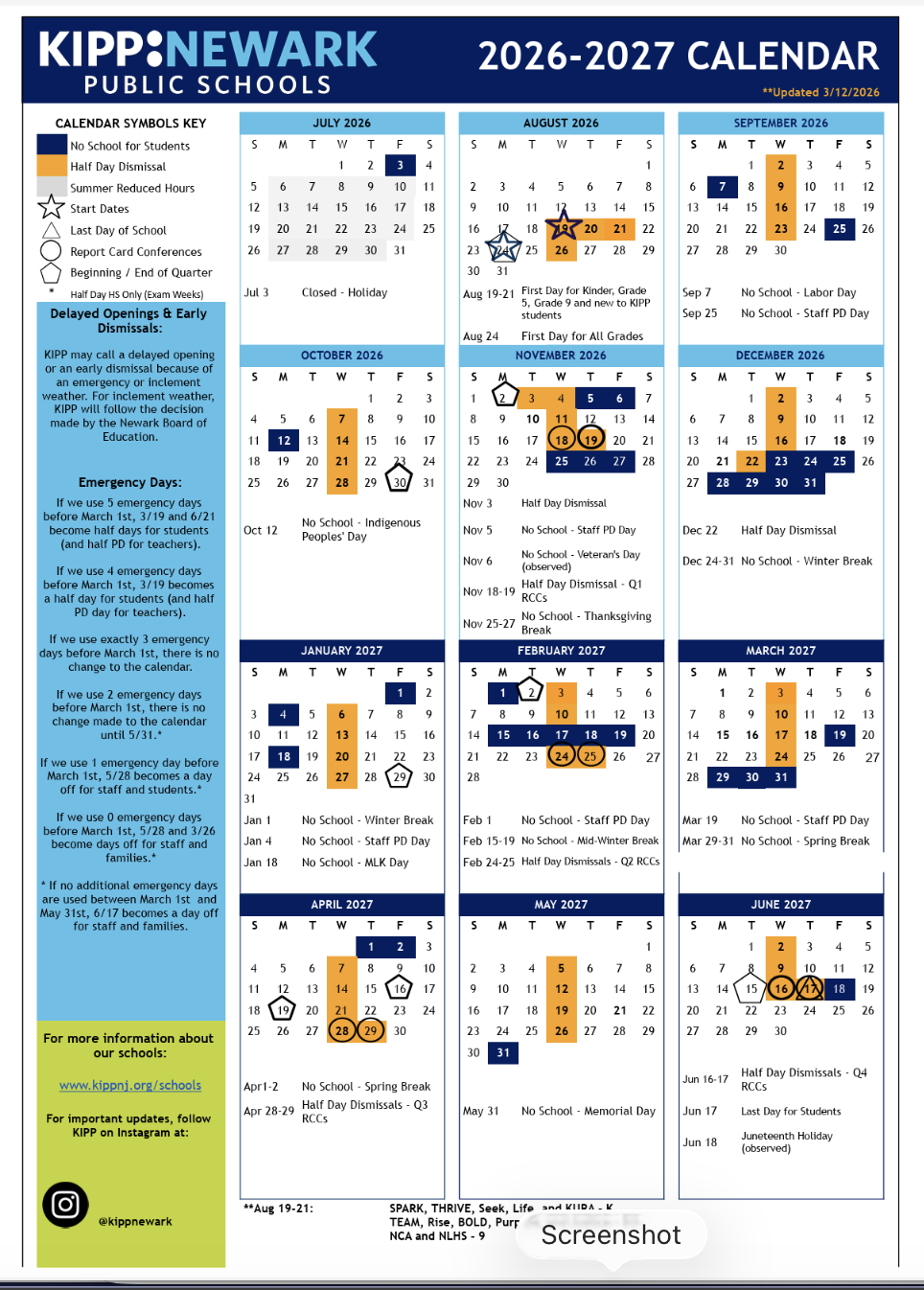
The SY 26-27 calendar.
Non-discrimination, HIB, substance abuse, acceptable use, gifted and talented, FERPA, child abuse, Title IX.
| School Info | |
|---|---|
| Grades Served 2026-2027 | 9-12 |
| School Phone | 973-757-1501 |
| School Fax | 973-718-4595 |
| School Address | 18 Norfolk Street, Newark, NJ 07103 |
| School Website | www.kippnj.org |
| School Colors | Red, Black, White, Gray |
| Role | Teammate |
|---|---|
| School Leader | Dr. Danielle Burroughs |
| Assistant School Leaders of Instruction | Matthew Daley Salisha Newsome George Smith Tashania Treasure-Johnson Michael Williams |
| Assistant School Leader of Special Education | Devin Rice |
| Assistant School Leaders of Culture | Sean Ogunnoiki — Upper School Kristina Douglas — Lower School |
| Associate Director of Student Life | Ariel Smith |
| Director of KIPP Forward | Jacolby Suggs |
| Associate Director of Athletics | Ryan Baylock |
| Deans of Students | Robert Reddick Jeran Crawford Dr. Jason Williams Marshenette Myers Quayon Boone Zaki Butler |
| Social Workers | Adaria Facchinei Shakayla Dingle Melissa Carrier Dalia Saleh |
| Director of Campus Operations | Jevonne Nichols |
| Associate Director of School Operations | Qadriyyah Hill |
| School Operations Manager | Ny-Asha Brame |
Staff email addresses are intentionally left off this page since the site is public. Everyone is reachable at their KIPP NJ address in the staff directory.
At Newark Lab High School we seek to develop and prepare every student to be productive citizens through rigorous academic instruction, serving within our school community and the community at large, and exposure to pre-collegiate and vocational opportunities. As a school, we own our data and work collectively to show sustained growth through an analysis of data. As the NLHS community, we hold ourselves to a standard of excellence both behaviorally and academically. We strive daily to be the best Sharks we can be!

| Cultural Vision | Newark Lab High School is an institution where staff models the behavior expected of students. Families are welcome to participate in the daily operations of the school. We hold each other accountable for being productive citizens both in the school community and at large. We celebrate the academic success of all students and create pathways for students to make more informed behavioral and academic choices. We understand that errors will happen and students will make mistakes but we use those mistakes as opportunities for growth. As a high school community, we value both physical and psychological safety and are committed to creating an environment where all stakeholders feel safe. We take pride in our school and represent our school positively by being our highest selves. Student achievement drives what we do as a school. |

|---|
Please note that KIPP Newark attempts to follow the NPS calendar as closely as possible. However, to implement our program, there are a few variations in the calendar. Please refer to the KIPP Newark calendar at the back of this handbook.
| Student Schedule | Student Schedule | Student Schedule |
|---|---|---|
| Monday, Tuesday, Thursday, Friday Block Schedule | Monday, Tuesday, Thursday, Friday Block Schedule | 7:50am - 3:40pm |
| Wednesday or Early Dismissal Days Block Schedule | Wednesday or Early Dismissal Days Block Schedule | 7:50am - 1:28pm |
| Staff Schedule | Staff Schedule | Staff Schedule |
|---|---|---|
| Monday - Friday | Monday - Friday | 7:40am - 4:15pm |
Newark Lab High School is a school that values rigorous academic instruction by certified professionals. We create opportunities for students to engage with academic material both during live instruction and after school in smaller groups. Data is analyzed by students, teachers, and families to ensure sustained student progress toward personal and schoolwide academic goals. Students know where they stand academically, and create growth goals for themselves. Advisors partner with parents, teachers, and students to aid in students achieving their academic goals. Student achievement drives what we do as a school.

| School’s Course Offerings | STEM Algebra I Algebra II College Algebra II Geometry AP Pre-Calc College Algebra (DE) Physics Biology Chemistry Human Anatomy & Physiology | Humanities English I (honors) English I English II English III English IV AP English Language & Composition US Government and Politics US History II US History: African-American and Latinx | Electives Art Dance I Dance Company Financial Literacy College and Career Readiness Dynamics of Health Care Occupations Computer Science Robotics Music Media Arts Physical Education and Health I-IV Spanish I-IV Spanish II - Honors Economics/Civics | SPED Algebra I-II ICR Concepts Foundations Geometry ICR Concepts Foundations Biology ICR Concepts Foundations Chemistry ICR Concepts Foundations Physics ICR Concepts Foundations English I-IV ICR Concepts Foundations Modern World History ICR Concepts US History: African American & Latinx ICR Concepts Foundations US History II ICR Concepts English as a second Language Family & Consumer Sciences Life Skills | Advance Placement & Dual Enrollment Courses AP English Language and Composition AP Seminar AP Pre-Calc AP US History AP World History: Modern AP Environmental Science College Literature (DE) College Algebra (DE) College Personal Finance (DE) |
|---|
| Student’s Arrival & Dismissal Procedures | Arrival: (7:50am - 8:13 am) All Students safely enter through Newark Street entrance. Tardy Arrival: (8:16 am - 10:30am) All Students safely enter through Norfolk Street entrance. Arrival after 10:30am Students will be allowed to enter but will not be marked present as per the State of New Jersey Guidelines that students must be in the building for at least 4 hours to be considered present. Dismissal: Mon,Tue, Thurs, Fri (3:40 pm - 3:45 pm) Wed (1:28 pm - 1:31 pm) Students safely exit through Newark Street doors. Students with Specialized Transportation safely exit through Norfolk Street doors. |
|---|
| Staff Arrival Expectations | Arrival Staff huddles begin promptly at 7:40am. Staff is expected to be seated and prepared to engage in morning huddles at 7:40 am. Late arrivals will be documented Tardiness Any arrival after 7:40 am is late. Three lates will result in an accountability conversation and accountability email from the manager . Failure to correct timeliness may result in the following instituted by the School Leader: Formal corrective action write-ups Professional Improvement Plan Suspension or Termination. |
|---|
| Staff Professional Dress Expectations | Professional Attire Worn: Monday, Tuesday, Thursday Tops Blouses (non-revealing/sheer) Cardigan/Blazer Collared/Button down shirts Ties Polo shirts Sweaters Bottoms Slacks(pants/trousers/corduroys/cargo) Skirts (no shorter than 1 inch above the knee) Dresses (no shorter than 1 inch above the knee) Suits Shoes Clean athletic shoes Loafers Boots Heels Head coverings Head wraps All religious head coverings Employees that fail to meet the stated professional dress expectation will be asked to change or take an unpaid day by being sent home. |
|---|
| Staff Dress Dressdown Expectations | Dressdown Attire Worn: Wednesday, Friday Tops: Wednesday KIPP, NLHS T-shirt, sweatshirt, sweater Tops: Friday College or Career T-shirt/sweatshirt, hoodie, sweater Bottoms Jeans Slacks(pants/trousers/corduroys/cargo) Shoes Clean athletic shoes Loafers Mules Boots Heels Head coverings Head wraps All religious head coverings Employees that fail to meet the stated dressdown expectation will be asked to change or take an unpaid day by being sent home. |
|---|
| Unacceptable Attire | All employees must remember at all times, we must conduct ourselves as professionals both in attire and speech. Unacceptable attire will not be allowed during unrestricted dressdown days unless clearance is given by the school leader. Tops Body suits Spaghetti Straps Tank tops Muscle shirts Shirts with profane language, images promoting smoking, or messages that spew hate Bottoms Sweatpants Shorts (higher than 1 inch above the knee) Skorts Mini-Skirts, Dresses (higher than 1 inch above the knee) Leggings Biker shorts Shoes Flip flops/Sandals Crocs Slides Yeezy Foam Runners Ugg Slippers Head coverings Hats Head scarf/Bandana Wave cap, skull cap Bonnets Employees that fail to meet the stated dressdown expectation will be asked to change or take an unpaid day by being sent home. |
|---|
| Staff Attendance Expectations | Newark Lab High School staff members are expected to be at work at 7:40am unless on an adjusted schedule. Teammates will report to the cafeteria or designated huddle room for a morning huddle. If you arrive after 7:40am you will be marked late. Your workday ends at 4:15pm. For the safety of our students please stay in the building until that time. Any arrival after 7:40 am is late. Three lates will result in an accountability email from manager. Failure to correct timeliness may result in the following instituted by the School Leader: Formal corrective action write-ups Professional Improvement Plan Suspension or Termination. _________________________________________________________ Requesting Time Off Email your AP and CC your respective grade level leadership team with at least two weeks advance notice. You are responsible for finding coverage for all periods including advisory and any duty you may hold. No PTO will be granted without a coverage plan FIRST. Wait for approval from your AP. DO NOT ASSUME PTO WAS APPROVED. Formal approval will be given by coach/AP in writing. Once approval is received, submit a formal requisition through ADP. Send outlooks to all stakeholders (grade level leadership and teammates covering) within 24 hours with coverage plans/directions included. Emergency Call-out Staff will only be permitted TWO emergency call-outs per quarter. Emergency call-out CALLS must be made by 5:30am to your GLC & GL AP. Emergency call-out EMAIL must be sent to the XLT listserv by 5:45 am. All assignments for classes must be shared by 6:00am with your AP if substitute plans are outdated. Staff members are REQUIRED to call and email when requesting an emergency call-out. Emergency call-outs made after 5:30am will be an unapproved unpaid day. Emergency call-outs exceeding three per quarter will be unapproved unpaid days. School Leader and AP will review each call-out and determine pay status. Email confirming paid or unpaid day will be sent within 24 hours. Emergency call-outs should be used only for sickness or emergencies. |

|---|
At KIPP, we believe our students are most successful when teachers and families form a partnership through open and regular communication about their education.
| School’s Parent-Teacher Communication | Parents should expect regular touch points throughout the year from their child’s advisor. Advisor will communicate with families via email or phone bi-weekly. Advisors must log two communications per month for each advisee. Bi-weekly progress reports and culture (behavioral) reports will be sent via email by the main office. Content teachers and paraprofessionals are responsible for contacting families with both affirming and adjusting student feedback. Contact can be via phone or email and logged in Deanslist. |
|---|
| HS | Parents are required to notify the main office at least 24 hours in advance if they would like to celebrate their child’s birthday during their child’s designated lunch period. |
|---|
To ensure the safety of our students and staff, all visitors to the school, including parents, must check in at the security desk. We use a visitor system which requires visitors to sign-in using a photo ID (driver’s license, preferred). Visitors are then given a visitor badge which must be worn while in the building. Even if one visits the school on a regular basis, they will still be required to sign-in using our visitor system. This also helps us to know who is in the building in the event there is an emergency. Visitors should also sign out at the security desk before leaving. If a visitor is not following the security procedures or are being disruptive in any way, our staff and security personnel reserve the right to ask them to leave or remove you from school grounds.
The safety of all students and staff in our schools is very important to us. In order to maintain a safe environment for our students to study and learn, it is necessary that we practice our emergency and crisis response plans by having drills designed to exercise our procedures.
Below are some examples of drills that are conducted at our school:
| FIRE DRILLS KIPP will conduct a “fire drill” each month that school is in session. This is a Fire Code and New Jersey requirement. It is important for every student and staff member to understand and be aware of the importance of this drill and not be afraid when the fire alarm sounds. By practicing, students and staff will know what to do and how to do it. LOCKDOWN DRILLS KIPP conducts “Lockdown Drills” throughout the school year. This type of drill will secure the school building and safely shelter all students, staff and visitors inside the building. The purpose of this drill is to keep the students and staff safe from any danger outside or inside the building. During a “Lockdown Drill,” all of the perimeter doors to the school building will be locked and will remain locked until the danger or issue outside or inside the building is removed. To enable everyone to remain safe in the event of a real emergency, no one will be allowed to enter the building or leave the building until the authorities authorize such a release. |
In the event of a real emergency, parents will receive an “all-call” similar to the calls we send out for weather-related closures or delays. As a result, it is extremely important that you provide the main office with up-to-date contact numbers. This is the fastest way for us to notify all families as school staff may not be able to answer phone calls or respond to texts during an emergency.
KIPP Newark schools typically follow the Newark Public Schools for all school closings, delays, and early dismissals during the winter weather months.
| Delay | KIPP Start Times | KIPP Start Times | KIPP Start Times |
|---|---|---|---|
| Delay | ES & BOLD | MS | HS |
| 1 Hour | 8:45 am | 9:00 am | 9:00 am |
| 90 Minutes | 9:15 am | 9:30 am | 9:30 am |
| 2 Hours | 9:45 am | 10:00 am | 10:00 am |
KIPP Newark will post closings, delays, and early dismissals on local news stations, our website, as well as our school Facebook and Instagram social media pages.
An “all-call” to families will be sent out when the school is closed, delayed or if we have an early dismissal due to weather. Please make sure the main office has a current phone number on file.
The KIPP Newark school calendar allows for 5 school days to be missed due to emergency or inclement weather. Emergency days are as follows:
If a student is asked or allowed to leave school before the normal dismissal time for that day for any reason, then the school will contact the parent or guardian, and the student must be handed off from the school directly to the parent or guardian or someone on the student’s “release/pick-up” list. Only KIPP students who are 18+ years old are allowed to sign themselves out.
It is important that we as a school community operate with the assumption that all members
are showing up as their best selves and upholding the commitments to their best ability. While
we know that there might be certain individual circumstances that impact our ability to uphold
these expectations, it is imperative that you communicate with the PD facilitator and AP.
lP Submission/Gradebook Submission
On Sunday’s you can expect a Weekly Blast that includes information from your SL, AP,
GLC, and Dean. It is your professional responsibility to read the blast before the 7:40am Monday huddle.
Homework & Teaching Materials:
NLHS teachers take full ownership over their Learning Environment. Not only are teachers and paraprofessionals responsible for the classroom climate and physical space, they are the first line of defense when addressing student behaviors. Consistent strong systems and routines aid in adverting negative student behaviors and promote an environment conducive to learning.
When someone walks into a NLHS learning space they will see:
Performance management at NLHS are the battery of tools that include, but are not limited to the
documents, professional development, observations, and feedback, used by the KIPP organization and
Newark Lab High School to evaluate instructional staff. All instructional staff are expected to perform as
effective teachers and deliver instruction that yields high academic results.
All instructional staff receive three major evaluations each academic year, in addition to those that are
performed daily/weekly .
| Performance Management Evaluation | When does this evaluation occur? | Additional Information: |
|---|---|---|
| Beginning-of-Year Conversation (BOY) | By the end of quarter 1 | Instructional staff receive short and long observations that culminate into a final Beginning-of-Year Conversation and ETR score. |
| Middle-of-Year Conversation (MOY) | Between quarters 2 and 3 | Instructional staff receive short and long observations that culminate into a final Middle-of-Year conversation and ETR score. |
| End-of-Year Conversation (EOY) | By the end of quarter 4 | Instructional staff receive short and long observations that culminate into a final End-of-Year conversation and ETR score. |
The Excellent Teaching Rubric (ETR) is the framework by which all instructional staff are evaluated
throughout the year during all observations. The five major areas by which instructional staff are
evaluated are the following:
1) Teaching is Thinking
2) Uphold Excellence
3) Kids Love Learning
4) No Struggle, No Progress
5) It Starts and Ends with Student Work
Performance management also includes a score provided to each staff member by their peers and
manager through Self & Others and Managers’ Surveys. The tiered ETR score, as well as, the Self &
Others and Managers’ scores from the middle and end of year reviews are averaged to provide a final score. Your final score determines how much your pay increase for the following year will be.
All instructional staff have a department TEAM that corresponds to the discipline they teach.
Department expectations include, but are not limited to the following:
● Complete lesson plans for all instructional days as per guidelines established by the KIPP:NJ network and NLHS Assistant Principals.
● Teach all instructional blocks for your discipline and support school intervention.
● Attend the full duration of all regional and school-based department meetings and professional development in person unless virtual options are made available.
● Communicate all requests for early leave and/or absenteeism in ADP, as well as, with your Grade Level Chair and Assistant Principal.
● Remain abreast of, respond to, and execute all department communication.
● Execute the vision for curriculum and instruction of the department.
● Sign in and out for all days of employment using the provided system.
● Consistently model and embody KIPP NJ values, professionalism expectations, and character.
All staff have a grade level TEAM. Grade level expectations include, but are not limited to the following:
● Attend the full duration of all grade levels huddles and meetings.
● Execute the grade level vision for culture and instruction.
● Execute all grade level duties.
● Communicate all requests for early leave and/or absenteeism in ADP, as well as, with your Grade Level Chair and Assistant Principal.
● Remain abreast of, respond to, and execute all grade level communication.
● Sign in and out for all days of employment using the provided system.
● Consistently model and embody KIPP NJ values, professionalism expectations, and character.
As an academic institution, it is imperative that the students in our care are provided an educational experience that allows them to be successful in their post-secondary educational experiences, as well as those they will encounter beyond our walls. As mentioned previously, each staff member is a professional at NLHS. All professionals are expected to consistently model and embody KIPP NJ values,professionalism expectations, and character. All communication, particularly those that involve breaches of professional duties, will be confirmed via email and/or writing.
Our middle and high schools use a points based grading system; categories are not weighted in their own right. A points based grading system is where the grade for the quarter can be calculated by dividing points earned by points assigned. Certain types of assignments still have more weight than others, but it is based on the amount of points the assignment is worth rather than an internal calculation.
Students’ grades are calculated based on their performance on the following types of assignments:
| Category | Description |
|---|---|
| WORK HABITS | This is classwork that is a measure of students' work ethic in the classroom. Classwork is graded for completion and mastery twice a week and each assignment is worth 10 points. Examples include: Problem Sets Independent work Exit Tickets Discussion |
| FORMATIVE ASSESSMENTS | Formative Assessments are a snapshot of students' mastery of the content. They are graded one time per week and each assignment is worth 10 points. Students can and should revise this work as they increase their mastery. |
| SUMMATIVE ASSESSMENTS | Summative Assessments are culminating measures of content mastery at the middle and/or end of a unit or quarter. There are usually two per quarter and they total 200 points. We expect students to prepare for these assessments by studying at home and completing study guides. |
| HOMEWORK | Homework assignments will be given weekly and are worth 10 points. Depending on the course, homework may be given daily, or a packet to complete for the week. Students are expected to complete their homework as it will significantly impact their overall grade. |
| Work Habits and Homework Rubric |
| Points | Description |
|---|---|
| 10 | Complete and meets/exceeds expectation - exemplary |
| 9 | Complete and meets expectation - adequate |
| 8 | Mostly Complete |
| 7 | Complete with many mistakes, does not meet expectations, or late |
| 6 | Attempts at completion are made, but work submitted does not meet expectations |
| 5 | Mostly incomplete, or submitted 2 weeks post-deadline - inadequate |
| 0 | Not submitted or academic dishonesty |
| Percent | Grade | Unweighted GPA Points | AP/Dual Enrollment Course GPA Points |
|---|---|---|---|
| 97-100 | A+ | 4.33 | 5.33 |
| 93-96 | A | 4 | 5 |
| 90-92 | A- | 3.67 | 4.67 |
| 87-89 | B+ | 3.33 | 4.33 |
| 83-86 | B | 3 | 4 |
| 80-82 | B- | 2.67 | 3.67 |
| 77-79 | C+ | 2.33 | 3.33 |
| 73-76 | C | 2 | 3 |
| 70-72 | C- | 1.67 | 2.67 |
| 67-69 | D+ | 1.33 | 2.33 |
| 63-66 | D | 1 | 2 |
| 60-62 | D- | 0.67 | 1.67 |
| 0-59 | F | 0 | 0 |
Students are able to earn Honor Roll based on their GPA in middle school and high school. To earn Honor Roll students must have a yearly GPA of 3.0 or higher. Each school has their own nomenclature for honor roll with distinguishing honor roll lists that are unique to the identity of the school.
Report cards will be distributed to families during the Family-Teacher conferences that will be held after the completion of each quarter. Conferences are scheduled for the following days:
| HS | Homework will be assigned in accordance with the scope of sequence of the course and recommendation of content Assistant Principal/Achievement Directors. |
|---|
Student absences have a significant impact on student learning. Students who are absent from school when an assignment is due are expected to submit that assignment upon returning to school. Students who are absent from school the day an assignment is given should be given one additional day to submit that assignment for each day they are absent.
Students have 1 week after the due date to turn in missing assignments. Students can earn full credit if the assignment is turned in within the 1 week window. Students can earn up to a 7 if the assignment is missing due to referred behavior (skipping class, eloping, etc.)
We want students to take full ownership for their course grades GPAs. Therefore, we believe that students should have opportunities to improve their grades by revising some types of assignments.
Students have the opportunity to revise any formative assessment that they did not receive full credit for. Regardless of type of a formative assignment, the students should be able to earn back all available points during the revision/re-take.
Mastery assessments (mastery quizzes, quarterly assessments, midterms, finals) will be graded using either a curve or conversion chart. Mastery assessment revisions are mandatory with the following parameters in place:
Students who submit test revisions can earn back up to 60% of the points that were missed. For example: a student who submits test revisions whose original curved/converted score was a 60 can earn up to 24 of the 40 points that were missed, for a final score of 84.
The lowest possible score a student can receive for an assessment is a 50, the numerical equivalent of an “F,” -- even if the student has missed the assessment altogether. This is also the lowest score that can be achieved on the conversion chart.
Students cannot revise work habit assignments.
At KIPP, we are committed to meeting the needs of all learners - including students who are gifted and talented. KIPP Newark will therefore provide all gifted and talented students with programs which provide for gifted and talented students’ basic education while encouraging optimum development of the students’ special abilities. Programs shall be developed or located which stimulate students to participate constructively in, and contribute to, the activities of the school, the community and society. The full Gifted and Talented Policy is available upon request to the school. *There is currently no gifted and talented program offered at Newark Lab High School.
At KIPP Newark, we will cultivate the academic, social-emotional, and character skills students need to lead choice-filled lives. These habits will be built in the learning environment with staff, students, families, and the community. We use a variety of developmentally appropriate methods (i.e., responses, conversations, incentives, recognition, and consequences) to teach necessary skills for students to make more informed choices. We envision a school where:
| School-specific behavior management systems | The HeartBEAT positive point system The HeartBEAT positive point system aims to encourage students to attain the high standard of behavior expected of them. It is imperative that we not only recognize when a student meets expectations, but exceed them as well. This is a system to monitor individual student’s conduct and help students make good decisions. The HeartBEAT points will encourage positive and responsible behavior. Students will earn points when they display values from our key principles (Be Kind - Effort - Accountability - TeamWork). Students can earn positive points for demonstrated behavior that is aligned to our core values, which can be redeemed for recognition and participation in events that celebrate and encourage their investment, engagement, and joy in school. However, engaging in behavior that goes against our code of conduct can result in consequences. |
|---|
KIPP believes that effective classroom management and a clear plan for discipline are essential for positive, productive classroom environments. Classroom management should center on proactive guidelines and procedures that establish clear expectations, foster engagement, and prevent misbehavior and confusion before they arise.
KIPP believes that discipline should be a learning experience in and of itself carried out with the students’ best interests in mind. Discipline should help teach students to be responsible and self-disciplined. Such an atmosphere must include the resources to support and teach student growth, respect for self, others, as well as for school based and community property.
| HS Accountability Systems | HS Accountability Systems |
|---|
| Tier | Infractions | Definition |
|---|---|---|
| Tier 1 | Disruptive Behavior/Hallway, Cafeteria, Study Hall, Assembly Inappropriate Behavior | Minor disruption of all or a significant portion of a campus activity, school-sponsored event, and / or school bus transportation. Disruptive behavior that poses a serious threat to the learning environment, health, safety, or welfare of others. |
| Tier 1 | Inappropriate language | Vulgar, crude, harmful, or indecent language directed at someone or used in a public space. |
| Tier 1 | Off Task/Not Following Directions | Head down, walking around the classroom without permission, talking without permission, participating in non-assigned activities, distracting others. . |
| Tier 1 | Late/Unauthorized Location | Late to class or in a location students should not be in. |
| Tier 2 | Cheating | Using unauthorized responses or work not originally created by the student to receive credit for school work, projects, or assigned tasks, as if it was your own. |
| Tier 2 | Refusal to fix dress code | Any student who does not adhere to the school’s set dress code policy (outwear, accessories, top, bottom, shoes). |
| Tier 2 | Use of technology for other than instruction | The use of any device, other than a chromebook or other school approved technology, that is visible or turned on during the class school hours, will be confiscated. |
| Tier 2 | Destruction of Property | Intentional defacing of school or personal property, including electronic devices, which includes writing, tearing or breaking items. |
| Tier 2 | Unauthorized Departure from Class | Leaving designated learning space without permission from supervising adults; eloping. |
| Tier 2 | Cutting Class | Student absent from class - when marked present at school - or away from designated learning environment for extended amount of time (as determined by school), without reasonable explanation or pass. |
| Tier 2 | Verbally or electronically threatening a staff member | Statement made to or about a staff member, verbally or electronically, with the intent to intimidate or cause any sort of harm |
| Tier 2 | Verbally or electronically threatening a peer | Statement made to or about a peer, verbally or electronically, with the intent to intimidate or cause any sort of harm |
| Tier 2 | Theft of school property | Taking property from the school community without permission of a school based adult. |
| Tier 2 | Theft of staff or peer property | Taking property from the school community; individually owned by another staff member or peer, without the owner's prior permission. |
| Tier 2 | Prolonged Tantrum | Any student that has an outburst of negative emotion and behavior for an occurrence or period of time that exceeds the scope of what is developmentally appropriate for that individual student. |
| Tier 2 | Disruptive behavior in shared spaces | Major disruption of all or a significant portion of a campus activity, school-sponsored event, and / or school bus transportation. Disruptive behavior that poses a serious threat to the learning environment, health, safety, or welfare of others. |
| Tier 2 | Refusal to submit technology to school officials | A Student refuses to turn in the device (Cell phone, earpods, any listening device or computer/tablet) after expectation is set. |
| Tier 3 | Unauthorized Departure from School | Exiting school campus/building without permission from authorized personnel. |
| Tier 3 | Physical Altercation (Fight) | A fight is defined as a physical altercation occurring between two or more students. The physical nature of a fight could include but is not limited to hitting, punching, slapping, poking, grabbing, pulling, tripping, kicking, and pinching. |
| Tier 3 | Assault of Staff | Any student that attempts to cause or purposely, knowingly, or recklessly causes bodily injury to another person. Some examples of this offense include: spitting in someone's face, hitting someone in order to cause them soreness, or slapping a person's face. |
| Tier 3 | Possession, sale, or distribution of a controlled illegal substance | Any student that possess, distribute, use or under the influence of alcohol or drugs while on school grounds or property, school bus or during school functions (on or off campus) |
| Tier 3 | Weapon Possession | Any student that possesses, distributes anything that is readily capable of lethal use or of inflicting serious bodily injury. |
Habits of Excellence Corrections are used to provide adjusting feedback at the end of the class period (during ‘Last 5’) for the few students who do not respond positively to MVP directions, positive narration, and least-invasive strategies.
| If a student is not meeting expectations after MVP directions and least invasive strategies are leveraged, the teacher should directly address/redirect the individual student for being off-task, not following directions, and/or side conversations. | |
| (N) Needs Improvement | The student demonstrated inconsistent effort and required several individual resets to meet class expectations. While some accountability was shown for their choices, they did not make the most of their class time. As a result, the BEAT values were not consistently demonstrated. |
| (U) Unsatisfactory | The student’s engagement and effort were minimal. Individual resets did not lead to any sustained adjustment in student’s performance. They avoided accountability, which negatively impacted their own work and the learning of others. The BEAT values were not demonstrated throughout the class. Or The student’s behavior escalated and disrupted the learning environment, resulting in removal from class.* *This does not apply to students experiencing a crisis. |
** For students with diagnosed disabilities that may impact behavior, the expectation is that the teacher is aware of the student’s disability, the behavioral accommodations and they are implementing the supports outlined in the IEP and 504 prior to delivering adjusting feedback.
Note: Before a teacher sends a message to the Dean and Assistant dean they should have tried at least 3 PICs (preventative intervention commitment). (seat change, buddy class, reset conversation, etc.)
Reasons that warrant a removal
● Inappropriate physical contact with students or staff
● Property destruction (Hole in walls, dismantling furniture,
breaking items, etc.)
● Possession of unsafe materials
● Leaving classroom or floor without permission
● Profanity (using inappropriate mature language)
● Chronic refusal to follow directions
● Theft
● Credible threats
If a student has to be removed the Dean of Students or Assistant Dean will:
At no point are teachers permitted to kick students out of the classroom. Teachers are permitted to ask students to step out to conference with them with the intent of having the student return to the class. If students refuse to step out or cannot meet the stated classroom expectations, the aforementioned referral procedure must be followed. Teachers cannot refuse a child entry into the classroom
Teachers that are unable to uphold this expectation will receive:
All Newark Lab High School students are required to wear the complete school uniform every day. Our uniform policy is designed to build a sense of pride within our school community and to ensure that our students look professional yet remain comfortable as they learn. Students must remain in uniform at all times while on campus.
The uniform will consist of one of the following:
Black NLHS Polo Shirt (long sleeve/short sleeve) and Black khakis or slacks. Black khaki (knee length) shorts may be worn in Quarter 1 and Quarter 4 only.
NLHS Gym Uniform - Gray NLHS gym shirt, gray NLHS sweatpants, and/or blue NLHS gym shorts.
In addition, the Newark Lab High School dress code includes the following:
Black NLHS Cardigan Sweater , Black V-Neck NLHS Crewneck Sweater, Grey or Black NLHS Fleece Jacket, Black NLHS ¼ Zip Sweatshirt
Lastly, the Newark Lab High School dress code excludes the following:
Hoodies, bonnets, hairnets, durags, scarves, sandals, crocks, ugg slippers, yeezy foam runners, and any open toed shoe.
Violations: Any accessory or article of clothing that becomes a distraction to the learning environment will be sent home with a note and will become a dress code violation if it is worn or brought back to school. Students who attend school dressed improperly may be required to call their parents/guardians to bring clothes meeting dress code requirements. Repeated violations of dress code or intentionally ignoring dress code expectations will result in additional consequences.
· Online: Go to www.flynnohara.com and follow the on-screen directions.
· Phone: Call 800-441-4122 M-F 9 am – 5 pm, Saturday 10 am – 2 pm
· Store: FlynnO'Hara Uniforms
544 Raymond Blvd.
Newark, NJ 07105
Regular attendance of students in each class and in school in general is critical to ensure students are able to learn and master the academic content and skills required for their grade level.
A parent/guardian must text or call the child’s advisor if the student will be absent. Parents/guardians should contact the advisor by 7:45 a.m. to report the reason for, and the expected duration of, the absence. A student must have attended at least 4 hours of school in a day to be considered present in school for the day.
An absence is either excused or unexcused. All absences are unexcused unless the absence is excused based on the approved policy, which is summarized below. Students and families are encouraged to familiarize themselves with the full policy, which is available on the website and at the school’s main office.
All excused and unexcused absences are included in attendance records.
Students absent for both excused or unexcused reasons are required to make up all coursework, including assessments. Students will have 2 calendar weeks to complete make-up work after an absence, but are encouraged to do so immediately upon return to school. Students should use Office Hours/Study Hall for this.
For the purpose of determining promotion, retention, truancy, grades, course credit, eligibility to make up missed assignments and tests for full credit, and violations of the school code of conduct for attendance the following absences are excused and not considered:
The following absences are unexcused. Unexcused absences are considered for the purpose of determining promotion, retention, truancy, grades, course credit, eligibility to make up missed assignments and tests for full credit, and violations of the school code of conduct for attendance:
The attendance policy, discipline and remedial measures shall apply to classified students where appropriate and in accordance with the student’s:
Students and STAFF may not participate in any school activities including, but not limited to, athletics, extra-curricular activities, school curricular programs, field trips, dances, etc. that take place during and after the end of the instructional day of an unexcused absence.
Students arriving late or leaving early must have attended school for at least 4 hours to be considered present in school for the day. A student who attends school less than 4 hours will not receive credit for attending that day.
If a parent/guardian fails to notify the school of a student’s absence then the school will contact the family that day. Families can track their child’s overall attendance and credit status via the attendance report distributed on DeansList every Thursday.
A student whose unexcused absences of the scheduled classes exceed the limits specified below may be retained and not promoted. Loss of credit will occur in all cases when a student has exceeded the following unexcused absences:
| Length of course | Unexcused Absences Limit |
|---|---|
| Full year | 18 |
| Semester | 8 |
A student will lose credit for all courses in a school year if the student’s unexcused absences exceed the allowable amount.
The school has established a process for a student to file a loss of credit appeal if the student exceeds the limits listed above. The Appeals Process can be found in the full Attendance Policy posted on the school website and also available at the school main office. Any appeal has firm filing deadlines.
| Length of course | Appeals Filing Deadline |
|---|---|
| Full year | 6/7/2027 (except for 12th graders who must file by 5/31/2027) |
| Semester for first half of academic year | 2/16/2027 |
| Semester for second half of academic year | 6/7/2027 (except for 12th graders who must file by 5/31/2027) |
Completion of make-up work, documentation of the reasons of the unexcused absences, as well as mastery of the subject matter are some of the factors that are used in assessing an appeal.
Students who are excessively absent are considered chronically absent. Students who are chronically absent miss more than 10% of the school year or more than 18 days absent. We cannot emphasize enough the impact absences have on student learning. Instructional learning builds on content from the previous day. If students miss school, they can quickly fall behind.
If your student becomes chronically absent, then you and your student will receive the interventions below:
| Number of Absences | Intervention | Resources |
|---|---|---|
| After 3 absences | Advisor and GLC schedule conference with family | Family Recommitment letter is signed |
| After 6 absences | GLC and AP schedule conference with family | Family Recommitment Letter 2 is signed |
| After 10 absences | AP and Dean of Students and Families scheduled conference with family | Attendance Letter with NJ Retention is signed |
| After 10+ absences | Continued meetings with Dean of Students and Families/ School Leader | Court complaints and Truancy Filings as necessary |
| Chronic Absenteeism Tracking | 1 | Report | Report Chronic Absent Tracking Report: Email Alert for Students with 3, 6, 10, 10+ Absences | GLC/LT Teams | 12:00 : automated daily | DeansList (via email notification) |
|---|---|---|---|---|---|---|
| Chronic Absenteeism Tracking | 2 | Contact Families | Enter contact / meeting with Families following Chronic Absenteeism protocol for each 3,6,10,10+ stage in DeansList Comm Log | GLC/LT Teams | Ongoing | DeansList (Comm Log) |
| Chronic Absenteeism Tracking | 3 | Report | Audit & Review: Chronic Absenteeism tracker to identify students at risk, latest interventions and track family contact | GLC/LT Teams | Ongoing | Data Tool (Chronic Absenteeism Tracker) |
The interventions listed above are only a few examples the schools will take to ensure your student comes to school each and every day. For serious offenses, additional interventions will be taken into consideration.
In order to fully implement our rigorous educational programs at KIPP Newark schools, we must make use of every minute. Students who arrive after 8:14 am are considered tardy. Students are required to sign in at the Swipe machine outside of the main office before going to class.
New Jersey state requires that students have at least 4 hours of instruction to be considered present. Therefore on Mondays, Tuesdays, Thursdays and Fridays students will be allowed to enter the building after 10:30 am but will not be marked present as per the state of NJ policy that they must be in the building for at least 4 hours to be considered present.
On Wednesdays students will be allowed to enter the building after 9:30 am but will not be marked present as per the state of NJ policy that they must be in the building for at least 4 hours to be considered present.
The end of the day is just as important as the beginning of the day. If your child has a medical or dental appointment or family emergency requiring you to come to school requesting an early dismissal, please notify the main office in advance. Parents/guardians are required to sign-out students from the main office for any early dismissal. Please try to arrange appointments for after school whenever possible. A student will only be dismissed to a parent or person listed on the authorized release list.
| HS | Main offices close for 20 minutes before dismissal and no early dismissals are permitted after the following times. 2:45 pm = M,T,Th,F 12:54 pm = W |
|---|
*times at shared campuses may vary depending on exact dismissal times and campus-wide activities.
In limited circumstances, it may be necessary for the school to provide a student with homebound instruction. Pursuant to N.J.A.C. 6A:16-10 et seq., the school may provide home instruction under the following circumstances:
At the end of each quarter and year, your child’s report card will include a Grade Point Average (GPA). At KIPP, we calculate GPAs by assigning a certain number of GPA points to every course grade a student earns and averaging those GPA points together. (See the table below for how course grades are used to determine GPA points.)
Your child’s Grade Point Average is an important measure of his or her academic performance. Your child’s high school GPA will have a big impact on your child’s college options:
Each quarter is worth 25% of a student’s overall grade for the year. Quarterly and unit assessments are counted as a mastery grade in each quarter. Students with IEPs will receive necessary accommodations and modifications to quarterly assessments. In High School, midterm and final exam grades are included in Quarter 2 and Quarter 4 grades respectively.
| Quarter | Weight |
|---|---|
| Quarter 1 | 25% |
| Quarter 2 | 25% |
| Quarter 3 | 25% |
| Quarter 4 | 25% |
We believe that, while the timeframe may differ for different students, all of our kids will ultimately be academically prepared to lead choice-filled lives. We recommend retention only when we believe that repeating a grade will benefit the student. Factors that we consider when making retention decisions include but are not limited to:
If your child is being retained in their current grade, your child’s school leader will communicate this decision to you by the last day of school.
Starting the 2026-27 school year, under this new policy, there will be a strict No Cell Phone Policy during school hours, including recess. This means all personal electronic devices must be switched off AND stored in designated lockers or Yondrs throughout the school day. This policy aims to create a distraction-free learning environment and ensure student safety and well-being. If a student gets caught with a cell phone in class after being provided lock boxes to place phone in the Dean will follow the policy below:
In order to keep an academic focused community we as a school and you as our Shark families must work together to support our students.
A student who violates classroom or school-wide rules may be subject to: verbal warnings, detention, loss of recess, assignment of writing a reflective summary of their behavior, conference with the teacher and/or principal, written note to parent/guardians, phone call to parents/guardians, parent - teacher conferences, and/or a consequence listed in our school policy. Consequences listed below carry a minimum and a maximum penalty. The consequence given to each student will be dependent on his/her prior behavior and number of behavioral incidents the student has accumulated during the school year. Teachers may send out a supplement to the stated district discipline.
Penalties may include: verbal warning, written notice to parent, parent-teacher conferences, detention, in-school suspension, short-term suspension (less than 10 days).
Parent - Administrator Conference , School Administrator will meet with parent/guardian to discuss the violation of the rule.
Detention - The student will be required to report to detention before and or after school, or during the school day as a consequence for a school or classroom violation.
In School reflection - Is a place for students to reset themselves, reflect in this space on their behavior away from their classmates and return back to class.
Aligned with the above, suspensions may occur as a result of code of conduct violations. The School Leader, or Assistant Principal, has the authority to suspend students up to 10 consecutive days. A suspension beyond 10 consecutive days requires the approval of the Executive Director and results in a formal hearing before a committee of the Board of Trustees. If suspended for 5 or more consecutive days for a code of conduct violation, a student will receive home instruction no later than the 5th day of suspension.
For the purposes of this document, weapons or dangerous instruments are broadly defined to include, but not limited to, those defined in N.J.S.A.2C:39-1f and 18 U.S.C. 921. Rifles, shotguns, machine guns, automatic or semiautomatic rifles, B.B. guns, dart guns, pellet guns, and other firearms; stilettos, and other knives which could inflict harm; blackjacks, bludgeons, metal knuckles, cesti or similar leather bands studded with metal fillings or razor blades embedded in wood; ice picks, razors, chains, bats, clubs, explosives; any weapon or other device which projects, releases, or emits tear gas or any other substance intended to provide temporary physical discomfort or permanent injury through being vaporized or otherwise dispensed in the air; and any other object that can reasonably be considered a weapon.
A student found or observed on school property or at a school-sponsored event to be in possession of a weapon or dangerous instrument, shall be reported to the School Leader immediately. The School Leader/designee shall immediately inform law enforcement officials. Disciplinary action shall be taken against students who possess, handle, transmit, or use weapons or dangerous instruments. As in all disciplinary cases, due process will be provided to the student. Disciplinary action imposed by the school may be in addition to sanctions levied by legal authorities. Any student who is convicted or found to be delinquent for the following offenses shall be immediately removed from the school's regular education program for a period of not less than one calendar year and placed in an alternative education school or program pending a hearing before the Board to remove the student: A. Possessing a firearm on any school property, on a school bus, or at a school-sponsored function; or B. Committing a crime while possessing a firearm.
We are committed to the safety and well-being of all students and their families in our schools. We recognize the harmful effects of drugs, alcohol, steroids and tobacco on student development, success, and life outcomes. As a result, we are committed to implementing wellness and recovery strategies to promote prevention, intervention, referral for evaluation, referral for treatment and continued care for drug, alcohol, steroids and tobacco use and abuse.
Students suspected of being under the influence of a substance will be referred to the nurse for screening. In accordance with N.J.S.A. 18A:40A-12 students suspected of being under the influence must immediately be evaluated by a physician.
For a summary of our Alcohol and Substance Abuse Policy, please see the Appendix.
At KIPP, we expect students to treat each other with civility and respect and will not tolerate acts of harassment, intimidation, or bullying. Like other disruptive or violent behaviors, this conduct interferes with the rights and abilities of students to learn and our ability to educate students in a safe and productive environment. Please see the Appendix for a summary of our HIB Policy.
If you believe your child or another student in the school is the victim of Harassment, Intimidation, or Bullying, please contact your school’s HIB Specialist:
| School-specific information | Sean Ogunnoiki Sogunnoiki@kippnj.org 732-570-9121 |
|---|
Plagiarism includes copying an idea or the actual text from another source and claiming that it is one’s own. Students must understand that copying the words, ideas, or opinions of someone else without giving credit to that person in the form of footnotes or references is considered plagiarism. Whether deliberate or accidental, plagiarism is a serious and punishable offense. Students must always be responsible for their own work and not engage in any manner of cheating.
| 1st Violation | Student will receive a grade of “0” for the assignment. They will be afforded an opportunity to resubmit the assignment and earn up to 7 points. Parent will be notified of the first integrity violation. |
|---|---|
| 2nd Violation | Student will receive a grade of “0” for the assignment, and complete a restorative form in the after-school restoration space. A parent meeting will be held with the Assistant Principal, Grade Level Dean, parent, and classroom teacher. |
| 3rd Violation | Student will receive a grade of “0” for the assignment, and complete a second restorative form in the subsequent after-school restoration space. A parent meeting will be held with the Assistant Principal, Grade Level Dean, and Parent. |
Access to KIPP’s internet network and technology is a privilege and must be treated as such by all users of the network and its associated systems. Our technological resources are intended to be used for educational activities. To ensure that our network remains secure, each and every user must protect the rights of the community. By using the school’s systems, each student agrees to follow our Acceptable Use Policy and all applicable laws. For a summary of our Acceptable use policy, please see the Appendix.
To ensure a safe, consistent, and trauma-informed response following any physical altercation or medical emergency, prioritizing:
This policy applies to:
KIPP Newark believes that all students can reach their potential. To this end, we provide special education services to students with an IEP or 504 plan. We have certified special education teachers, paraprofessionals, related service providers, social workers, and school psychologists to provide on-going support to students who have been identified as qualifying for special educational services.
KIPP Newark is required by the Individuals with Disability Education Act (IDEA) to provide free, appropriate public education to children with disabilities who need special education and related services. New Jersey has adopted state laws that conform to the IDEA and which schools must follow. Under New Jersey Administrative Code Title 6A, Chapter 14, students between the ages of 3 and 21 are eligible for special education and related services if they meet the criteria for one or more of fourteen recognized disabilities. Eligibility is determined collaboratively by the Child Study Team, who can recommend classification only if the student’s academic deficiencies are not the result of “a lack of instruction in reading, including the essential components of reading instruction, or math or due to limited English proficiency” (NJAC 6A:14-3.5(b)). Students are eligible for special education, assistive technology, and related services if they need specially designed instruction and have one or more of the following physical and/or mental disabilities: auditorily impaired, autistic, intellectual disability, communication impaired, emotionally disturbed, multiply disabled, deaf/blindness, orthopedically impaired, other health impaired, social maladjustment, specific learning disability, traumatic brain injury, visually impaired, and/or preschool child with a disability.
An IEP, or Individualized Education Plan, is a written support plan when a student is identified with a disability. This document describes a child’s needs and explains the specific services that the school will provide a student to make progress in school.
The IEP is written by a team of professionals and a student’s parents/guardians. In New Jersey this team is referred to as the Child Study Team. Parents/guardians are invited to all IEP meetings. A student is also invited to the meeting if his or her post-secondary goals and transition needs will be discussed at the meeting (this is required if the child will turn 14 during the next school year). If transition needs are not going to be discussed, then the parent or guardian can decide whether the child should attend the meeting. Parent and student input during these meetings is valued and encouraged.
After the IEP is written, parents and guardians are asked to sign the IEP. By signing this document, a parent indicates approval of the program and services described and identified on the student’s IEP. More information about the special education process can be found in the Parental Rights in Special Education (PRISE). This manual informs parents of their rights related to their child with a disability and is provided annually to parents.
Some school age children with disabilities who do not meet special education eligibility requirements might still be eligible for special protections and for adaptations and accommodations in instruction, facilities, and activities under Section 504 of the Federal Rehabilitation Act of 1973.
A student is eligible for Section 504 protections and supports if he or she meets the following criteria:
KIPP Newark schools must ensure that qualified students with disabilities have equal opportunity to participate in the school program and activities to the maximum extent appropriate for each individual student. Without discrimination or cost to the student or family, we provide each qualifying protected student with a disability the relevant aids, services or accommodations which are needed to provide equal opportunity to participate in and obtain the benefits of the school program and extracurricular activities to the maximum extent appropriate to the student’s abilities and to the extent required by these laws. These supports and accommodations are documented in a Section 504 Service Agreement.
If you suspect that your child may qualify as a protected student with a disability, please contact the school social worker or Assistant Principal of Special Education to request an evaluation.
KIPP Newark schools provide non-English or limited English Language Learners (ELL) with English language instruction and cultural orientation. The goal of the ELL Program is to have students attain English language proficiency to enable them to succeed in school and in the community.
Parents of all incoming students are asked to complete a Home Language Survey as part of the registration process. Information from the survey is used to identify and screen students who may be eligible for ELL supports.
English Language Learners participate in annual state assessments with allowable accommodations annually. Students are graded using the same grading system as other students. English Language Learners, who are also students with a disability, are eligible for special education supports. A student’s individual supports are determined at an IEP team meeting taking into consideration the child’s unique strengths and instructional support needs.
Students exit KIPP Newark’s ELL program based on New Jersey multiple measures exit criteria. Students are monitored for two years after exiting ELL using a review of grades, school-wide assessments, state assessments (NJSLA), and teacher observations.
Response to Intervention (RtI) is a multi-tier approach to the early identification and support of students with learning and behavior needs by utilizing a problem-solving framework to identify and address academic and behavioral difficulties for all students using scientific, research-based instruction.
RtI is the practice of:
The RtI process begins with high-quality instruction and universal screening of all children in the general education classroom. Struggling learners are provided with interventions at increasing levels of intensity to accelerate their rate of learning. These services may be provided by a variety of staff members, including general education teachers, special educators, and specialists.
Progress is closely monitored to assess both the learning rate and level of performance of individual students. Educational decisions about the intensity and duration of interventions are based on individual student response to the instruction. RtI is designed for use when making decisions in both general education and special education, creating a well-integrated system of instruction and intervention guided by student outcome data.
Referral to RtI is not to be considered as a first step to Child Study Team evaluation. Quite the opposite, it is designed to provide necessary time-bound interventions for a student to make adequate academic progress. Response to Intervention is better described as a “response to instruction.” It provides a triage process that allows for progressive increases in the intensity and duration of instruction for students who continue to struggle with the general education curriculum. Through this preventive process, schools can meet the needs of all students and reduce the number of students inappropriately identified with a specific learning disability.
The Family Educational Rights and Privacy Act (FERPA) affords parents and students who are 18 years of age or older ("eligible students") certain rights with respect to the student's education records. KIPP Newark complies fully with this federal law. For a summary of KIPP’s FERPA policy, please see the Appendix.
Unless a parent or guardian grants KIPP permission during the enrollment process, KIPP Newark will not distribute or display photographs, video or audio footage of your child. If you do provide KIPP with this permission, we may make these photographs, video, or audio footage available for public viewing by various media outlets.
We are committed to equal opportunity for all of our students. We prohibit discriminatory practices against any person by reason of race, color, national origin, ancestry, age, sex, pregnancy, affectional or sexual orientation, gender identity or expression, marital status, domestic partnership status, familial status, liability for service in the Armed Forces of the United States, nationality, atypical hereditary cellular or blood trait of any individual, genetic information, or refusal to submit to a genetic test or make the results of a genetic test known, on account of disability, social or economic status, pregnancy, childbirth, actual or potential parenthood, or family status.
Student safety is our first priority. All school staff are mandated reporters of child abuse and neglect and are legally required to call the Division of Child Protection and Permanency if there is suspected child abuse or neglect.
In New Jersey, anyone with reasonable cause to believe a child is being abused should immediately call the Child Abuse Hotline. If the child is in immediate danger, call 911 as well as 1-877 NJ ABUSE. Calls can be made anonymously and you do not need proof to report an allegation of child abuse. The Hotline is available 24 hours a day, seven days a week.
Examples of abuse and neglect include-
When a student reports:
When a staff member suspects or witnesses:
When parents/guardians:
Any person having reasonable cause to believe that a child has been abused or neglected has a legal responsibility to report it to the Division of Child Protection and Permanency at 1-877-NJ ABUSE (652-2873).
The School Leader or his/her designee may conduct a search of a student’s person or belongings if the search is necessary to maintain discipline and order in the school, and the school official has a reasonable suspicion that the student is concealing contraband. All searches and seizures conducted by designated school staff shall comply with the standards prescribed by previous court decisions and in compliance with applicable law.
All persons and belongings entering our buildings are subject to search by security personnel, including use of metal detectors.
Policy: Staff Transporting Students in Private Vehicles
The KIPP Newark 2026-2027 academic calendar, including report card conferences, half days, staff PD days, and the emergency-day rules that shift dates at the end of the year.

Calendar updated 3/12/2026. Emergency-day rules that shift 3/19, 5/28, 3/26 and 6/17 are printed in the left column of the calendar.
We are committed to equal opportunity for all of our students. We prohibit discriminatory practices against any person by reason of race, color, national origin, ancestry, age, sex, pregnancy, affectional or sexual orientation, gender identity or expression, marital status, domestic partnership status, familial status, liability for service in the Armed Forces of the United States, nationality, atypical hereditary cellular or blood trait of any individual, genetic information, or refusal to submit to a genetic test or make the results of a genetic test known, on account of disability, social or economic status, pregnancy, childbirth, actual or potential parenthood, or family status.
The Board of Trustees expects students to treat each other with civility and respect and will not tolerate acts of harassment, intimidation, or bullying. Like other disruptive or violent behaviors, this conduct interferes with the rights and abilities of students to learn and our ability to educate students in a safe and productive environment.
The Board prohibits acts of harassment, intimidation, or bullying against any student.
"Harassment, intimidation or bullying" are defined as any gesture or any written, verbal or physical act, inclusive of the use of cell phones, electronic communication devices, or other electronic devices, whether it be a single incident or a series of incidents, that is reasonably perceived as being motivated either by any actual or perceived characteristic, such as race, color, religion, ancestry, national origin, gender, sexual orientation, gender identity and expression, or a mental, physical or sensory disability, or by any other distinguishing characteristic, that takes place on school property, at any school- sponsored function, on a school bus, or off school grounds, that substantially disrupts or interferes with the orderly operation of the school or the rights of other students and that:
Within one school day of receipt of a written report of an incident, the School Leader may initiate an investigation at his or her discretion, which shall be conducted by a school anti-bullying specialist (and additional personnel appointed by the School Leader, if necessary). The investigation shall be completed at the latest within 10 days of receipt of the written report. The results of the investigation shall be reported to the Board of Trustees no later than the date of the Board meeting next following completion of the investigation. Information presented to the Board shall include, but shall not be limited to, training established, discipline imposed, or any other action taken or recommended by the School Leader.
Pursuant to state law, schools have the right to interview students without parents being present.
Parents/guardians of students who are parties to the investigation shall be entitled to receive information about the investigation. This information shall be provided within 5 school days after the results of the investigation are reported to the Board. A parent/guardian may request a hearing before the Board after receiving the information, which shall be held within 10 days of the request during executive session. At the hearing, the Board may hear from the school anti-bullying specialist about the incident, recommendations for discipline or services, and any training programs instituted.
At the next Board of Trustees meeting following its receipt of the report, the Board shall issue a decision, in writing, to affirm, reject or modify the School Leader’s decision.
Consequences and appropriate remedial actions for a student who commits an act of harassment, intimidation, or bullying shall be determined by the School Leader and may range from positive behavioral interventions up to and including suspension or expulsion. In considering what response is appropriate, the School Leader shall consider the nature and circumstances of the act, the degree of harm to all individuals involved, the nature and severity of the behavior, past incidences or past or continuing patterns of behavior, and the context in which the alleged incident(s) occurred.
Any employee, student, volunteer, or member of the public who witnesses or has reliable information that any student has been subject to harassment, intimidation or bullying as defined in this policy must report the incident to the appropriate school official designated by the administration. The Board will not tolerate any act of reprisal or retaliation against any person who reports an act of harassment, intimidation, or bullying. Individuals are also prohibited from falsely accusing another as a means of retaliation or as a means of harassment, intimidation, or bullying.
The full HIB policy, including any revisions after the date of this handbook’s publication, can be found online at: https://kippnj.org/compliance.
We are committed to the safety and well-being of all scholars and their families in our schools. All staff receive training and education on substance abuse prevention and intervention to ensure we are creating and maintaining a safe learning environment for all scholars. We recognize the harmful effects of drugs, alcohol, steroids and tobacco on scholar development, success, and life outcomes. As a result, we are committed to implementing wellness and recovery strategies to promote prevention, intervention, referral for evaluation, referral for treatment and continued care for drug, alcohol, steroids and tobacco use and abuse.
In accordance with N.J.S.A. 26:3D-17, the use of tobacco products and smoking of any substance is prohibited in school buildings and on school grounds. We are committed to promoting a healthy learning and working environment, free from unwanted smoke, for our scholars, family, and visitors.
The following are strictly prohibited:
Students are not permitted to use or possess any tobacco products or smoking device on school grounds or property, school bus or during school functions (on or off campus). Possession or use of an electronic smoking device, which includes electronic cigarettes (e-cigarettes), cigar, cigarillo, cartridges or pipe which is a nicotine delivery device that allows consumers to inhale electronically vaporized nicotine water is prohibited.
The comprehensive alcohol and substance abuse policy is available at your child’s school upon request.
The School Leader or his/her designee may conduct a search of a student’s person or belongings if the search is necessary to maintain discipline and order in the school, and the school official has a reasonable suspicion that the student is concealing contraband. All searches and seizures conducted by designated school staff shall comply with the standards prescribed by previous court decisions and in compliance with applicable law.
All persons and belongings entering our buildings are subject to search by security personnel, including use of metal detectors.
Access to our network is a privilege and must be treated as such by all users of the network and its associated systems. Our technological resources are intended to be used for educational activities. To ensure that our network remains secure, each and every user must protect the rights of the community. By using the school’s systems, each student agrees to follow this policy and all applicable laws.
The school reserves the right to take immediate action regarding activities that (1) violate this policy or law, or (2) create security and/or safety issues for the school, students, employees, schools, network or computer resources, or (3) expend school resources on content that the school determines lacks legitimate educational purpose, or (4) the school determines are inappropriate.
Our full policy is available upon request at your child’s school.
The school will provide all gifted and talented students with programs which provide for gifted and talented students basic education while encouraging optimum development of the students’ special abilities. Programs shall be developed or located which stimulate students to participate constructively in, and contribute to, the activities of the school, the community and society.
The full Gifted and Talented Policy is available upon request to the school.
The Family Educational Rights and Privacy Act (FERPA) affords parents and students who are 18 years of age or older ("eligible students") certain rights with respect to the student's education records. These rights are:
The Family Educational Rights and Privacy Act (FERPA) requires that the district, with certain exceptions, obtain parent/guardian consent prior to the disclosure of personally identifiable information from a child’s educational records. However, the district may disclose appropriately designated “directory information” without written consent, unless the parent/guardian has advised the district to the contrary. The primary purpose of directory information, which is information that is generally not considered harmful or an invasion of privacy if released, is to allow the district to include this type of information in certain school publications. Examples include:
Directory information can be disclosed to outside organizations without a parent’s prior written consent.
The district, has designated the following information as directory information:
If you do not want the district to disclose any of the above-listed directory information about your child you must notify the school. Absent this notification it will be assumed you consent to having your child’s information available as directory information.
Student safety is our first priority. All school staff are mandated reporters of child abuse and neglect and are legally required to call the Division of Child Protection and Permanency if there is suspected child abuse or neglect.
In New Jersey, anyone with reasonable cause to believe a child is being abused should immediately call the Child Abuse Hotline. If the child is in immediate danger, call 911 as well as 1-877 NJ ABUSE. Calls can be made anonymously and you do not need proof to report an allegation of child abuse. The Hotline is available 24 hours a day, seven days a week.
Examples of abuse and neglect include-
When a student reports:
When a staff member suspects or witnesses:
When parents/guardians:
Any person having reasonable cause to believe that a child has been abused or neglected has a legal responsibility to report it to the Division of Child Protection and Permanency at 1-877-NJ ABUSE (652-2873).
We are committed to providing students, employees, and volunteers with an environment that is safe, welcoming, and inclusive. We take seriously its obligations to ensure that no student or employee suffers discrimination on the basis of sex, as defined in Title IX of the Education Amendments Act of 1972 (“Title IX”). Title IX requires that “[n]o person in the United States shall, on the basis of sex, be excluded from participation in, be denied the benefits of, or be subjected to discrimination under any education program or activity receiving Federal financial assistance...” 20 U.S.C. § 1681(a). We do not discriminate against or tolerate discrimination against students, employees, or applicants on the basis of actual or perceived sex, sexual orientation, gender identity or expression.
The following acts are prohibited and will not be tolerated:
Any person may report sex discrimination, whether or not the person reporting is the person alleged to be the victim of sexual harassment, in person, by mail, by telephone, or by electronic mail.
Reports may be made to any staff member with whom the person reporting feels comfortable, including our Title IX Coordinator, any teacher, counselor, the school Assistant Principal, the school Principal/designee, or any Dean. A report may be made at any time (including during non-school hours) and as soon as possible in order for us to maximize our ability to respond promptly and effectively.
Our complete Title IX policy, process, and contact information can be found at https://kippnj.org/titleix/ or at your school’s main office.
Social media has become a powerful communication tool. With the power of social media come responsibilities. These guidelines provide best practices under which members of the KIPP community (families, teachers, students, and staff) should operate when using these tools. The basic principle is that community members are expected to adhere to the same levels of civility in their online and face-to-face conversations. The same laws, school policies, guidelines, and personal and professional expectations for interacting with all KIPP community members apply online as in the real world. For example, posting defamatory or confidential information about students or teachers may violate existing school policies and be handled as such.
Family members who engage in disrespectful or disruptive behavior on social media and/or while on campus may have their access to campus revoked or limited, per KIPP NJ policy. Off-campus conduct that interferes with the orderly operation of the school may result in discipline to a child under the student code of conduct.
Harmful social media posts not only negatively impact our community, but make it more difficult for our school team to respond to and resolve issues quickly and effectively, especially in instances where student privacy is at stake. We encourage everyone to consider the unintended and long-term effects of social media posts that may refer to or include children, whether family or otherwise. In order to maintain an environment where all students can thrive, our expectation is that all KIPP family members also maintain mutually respectful relationships with all school staff.
We also encourage all families to speak with their children about the potential negative impact of social media and the consequences of engaging in behavior that negatively impacts others, and to actively partner with their child’s school in ensuring that your child does not engage in unsafe or harmful behavior outside of school.
We will investigate any threat made toward the school or our school community (by anyone) which may also include involving the police and/or other authorities in the investigation.
Since social media are constantly changing, these best practices may be updated frequently.
See our Code of Conduct for our policies and procedures in dealing with conflict.
An effective, instructional program requires an orderly school environment, and the effectiveness of the educational program is, in part, reflected in the behavior of students. Such an environment includes respect for self and others, as well as for district and community property.
KIPP’s first priority is to ensure the well-being, safety, and protection of each of its students as well as the adults who work and volunteer at the school. Healthy, supportive relationships are a pillar of the KIPP community.
Staff, Students, and Families should be aware that the following practices are followed at KIPP:
If students or families are aware of any violation of the above policy then it should be immediately reported to the School Leader.